Once again begins with a recap of the last lecture. Talks about the alveolar gas equation as well as the inverse relationship between alveolar ventilation and PACO2 (which make sense, more breathng less CO2 in the lungs).
Problems with gas exchange
When we don’t get enough loading of 02 into blood (high ∆A-a) this is usually due to 3 main(ish) causes:
1. Impaired diffusion
The causes of impaired diffusion are per Fick’s law:
- Thickening of the diffusion barrier
- Decrease in the surface area
- Exercise (P/q mismatch?)
- Breathing low O2 mix (not sure about this one either)
Some comments on the diffusion of oxygen:
As per diagram: 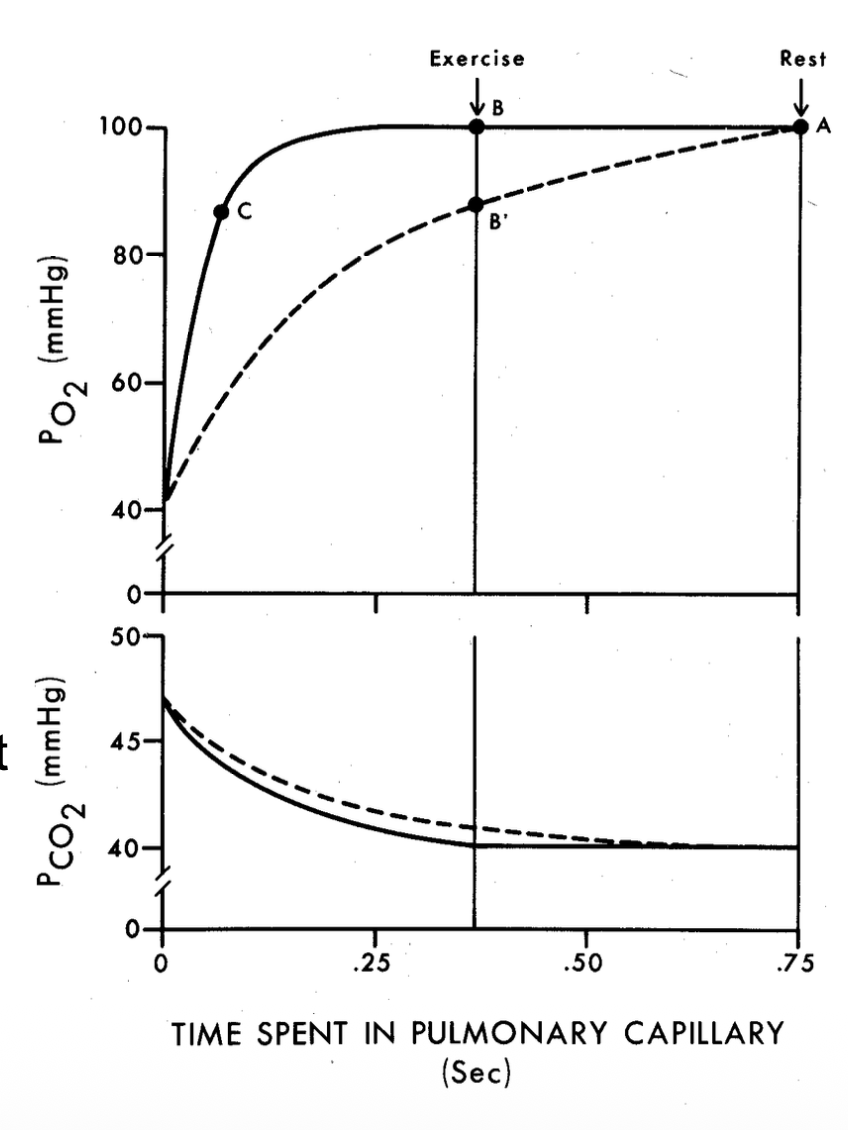 you can see that the time each erythrocyte spends in the pulmonary capillaries is about 0.75 seconds in the pulmonary capillaries. in a healthy individual equilibrium is reached in about 0.25 seconds. You need significant impairment before you get reduced PAO2 at result. However with exercise the time spend in a capillary shortens to 0.25 or so seconds. this can lead to appreciable problems with diffusion. This issue will have good response to extra O2.
CO2 diffusion is rarely impaired. its diffusion constant is 23x that of oxygen.
2. Shunt
this is where blood reenters the pulmonary venous drainage without being reoxygenated, diluting oxygenation of the other blood. this may be anatomical, blood being directed to areas what just aren’t full of exchange surfaces, or it could be pathological, eg pneumonia where alveoli are filled with pus. shunts respond poorly to additional oxygen.
3. Ventilation-diffusion mismatch recomplete with watching lecture
this is where the perfusion of blood and the ventilation of the alveoli are not matched for best diffusion. either blood is perfusion at too high a rate for the ventilation which results in blood leaving not having full oxygenation/ full decarbonation, or ventilation is wasted on slow moving blood. in the case of fast blood extra o2 is beneficial
Arterial hypoxaemia
can be caused by (REMEMBER THIS)
- reduced PB or FIO2
- hypoventilation
- impaired diffusion
- Shunt
- V/Q mismatch
Keeps going about the content in the last lecture. Brings up this neat graph on hypo vs hyperventilation.

Causes of hypoventilation
Hypoventilation
Key properties always increases PaCO2 decreases PaO2 but this is reverible by adding higher concentration oxygen.
Causes:
- high work of breathing
- Damage to chest wall or fatigue
- Respiratory depressants (morphine/barbituates)
- Sleep
Respiratory failure
PaO2 <60 mmHg or PaCO2 >55mmHg Can be type 1 or type 2
Type I PaO2 low PaCO2 normal gas exchagne problems, V/Q dhunt. pneumonia
Type II PaO2 low PaCO2 high ventilatory failure Chronic bronchitis, emphysema