Summary of diencephalon
- thalamus gateway to the cortex containa s number of nuclei mediating sensation motot cortical arousal learining memebry
- hypothalamus autonomic control endocrine center for emotional resonse
- pineal gland produces melatonin contains calcium salts
visual processing
the half of your eye which is closes to the nose is nasal retina and the lateral side is temporal retina.
the left nasal and right temporal both see left side of the world and then from there both report to right side of occipital lobe
the contralateral side crosses at optic chiasma
primary visual corted
- basic information conscious perception of visual images visual association areas
- processes visual inforamtion concerned with form volour and movement complex visual processing
- ventral temporal lobe- what am i seeing
- parietal cortex - where am i seeing it
- frontal cortex - using it to guide movement
Overall objectives
- Be able to identify and describe the key structiues involved in learning and memory particularly the hippo campus
- Alzheimers disease
- brain regions affected pathological hallmarks, amyloid cascade hypothesis, challanges
memory
episodic memory - personal epidosea in time and space relies on hippo campus
hippocampus 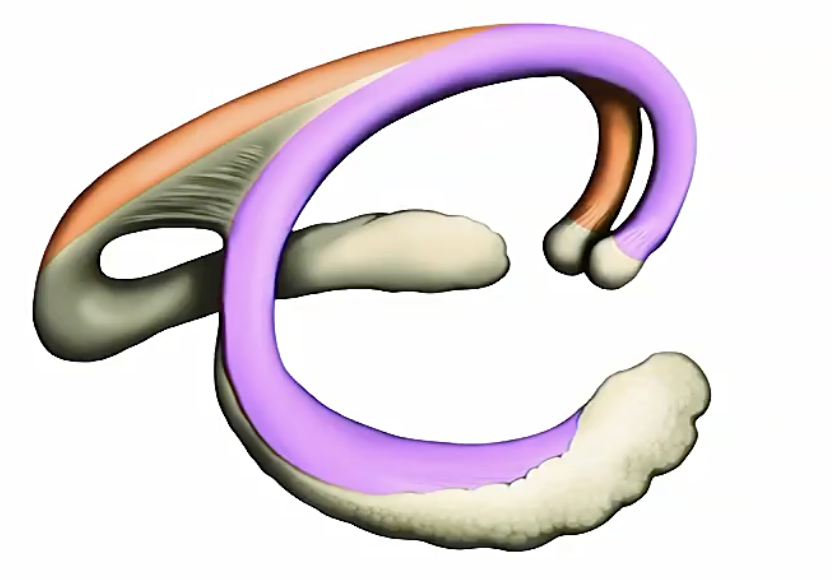 the location of the hippocampus medially traces the inferior lateral ventricle horns
fimbria are fibres which connect the hippocampus to other stuff fimbria → crus → body → columns
mamillary bodies are of the hypothalamus and columns connect to these
medial temporal lobe houses the parahippocampad gyrus
the hippocampus has the dentate gyrus, CA fields subiculum and pre-subiculum and parasubiculum this gyrus has rhinal sulcus, perirhinal cortex, parahippocampal cortex
Medial temportal lobe memroy system
- hippocamal fomation (where)
- hippocampus
- CA fields
- Dentate gyrus
- subiculum
- hippocampus
- parahippocampal region (what)
- pre- parasubiculum
- entorhinal cortex
- perrhinal corted
- parahippocampal cortex
hippocampal formation and parahippocampal region has interconnections
patient HM has a bilateral mtl resection and developed retrograde and anterograde amnesia
pateind RB sustained cardiac arrest and permanent anterograde amnessia. this was dues to hippocampal ca1 cell loss
Place cells - head direction cells - fires when animal orient its head grid cells-
Alzheimers
Alzheimer disease is a type of dementia it is characterised by increasing memory loss
early warning sympotns
- memory loss affesting job skills
- difficult performing familiar tasks
- problems with languahe
- disortientation of time and plance
- poor judgement
- pronlems with abstract thinking
- misplacing things
- changes in mood or behaviour
- changes in personality
- loss of initiative
person cannot communicate verbally undersnad words or instriuction recognise seld recognise familt members care for themselces
anantomic changes we see increased brain atrophy and increased ventricles
Neuropathology we see some pathologies called senile plaques and neurofibrillary tangles
these come from amyloid precursor protein this is a membrain protein and can be cleaved through a few wats
- non maylogenic processing this is cleavved by a secretase and then gamma secretase
- amylofenic prossessing the protein is cleaved by b secretase and this leads to toxic AB protein plaques
tau protein promotes microtubule assembly and stabilisation.
tau can tangle together to form the tangles leading to cell death.
the tangles always occur earlt in the entorhinal and perirhinal cortices then hippo campus then frontal and perietal lobes
amount of tandles parallels the durationa nd severity of the AD
the cerebellum is never affected by tangles and its hard to know ehy
braak stages detail this progression and the clinical changes
time of onset etc
early onset is genetic and is in < 65 yrs
95% of cases are sporadic with age as the primary predictor
amyloid cascade this is a hypothesis on the pathyphysiology leading to AD
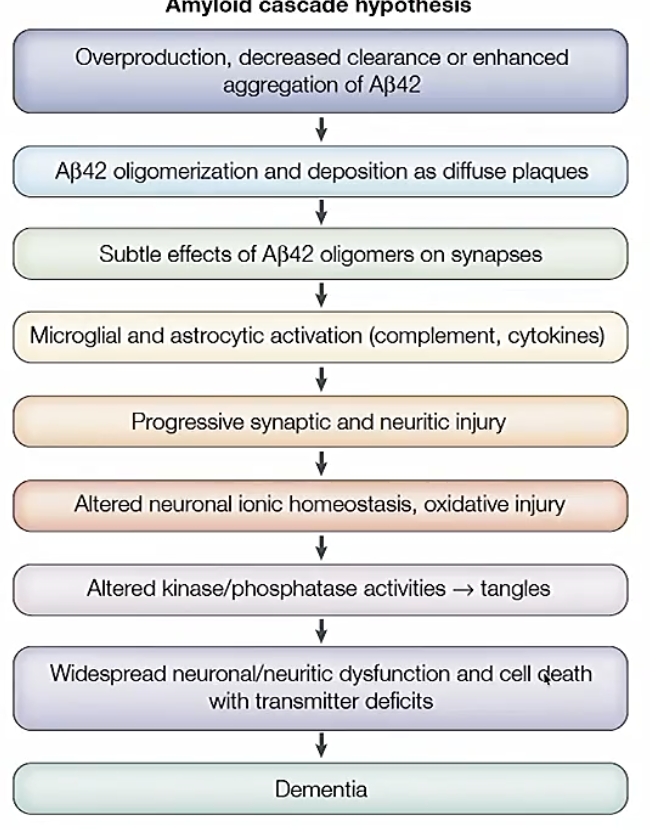
challanges in AD lots of challanges to the amyloid cascade hypothesis
and so more research needs to be done
two hit model of AD cerebrovascular damage initially is the source of neuronal injury and neurodegeration but promotes accumulation of AB toxin ( 2nd hit.)
no cure for AD treatments include
early biomarkers can serve to be early detection points
best preventative is lifestyle intervention and promote successful aging