Most important
The brain grows in a specific neurosequence and in the sequence it has different needs to be met at certain times. Clinically this is important because when the child is exposed to specific stressors and adversity the severity matters on the timing because the brain will have different absolute needs at different times.
It depends on what is growing in the brain and what the specific needs are, and this will lead to one seeing what is going to be impaired later in life by this adversity
Essentially brain development is:
- Sequential Regulation → movement → emotion→ cognition
- Experience dependant Neural pathways strengthen through repeated interaction and environment
- Relational Responsive caregiving and connection shape regulation and resilience
- Biologically sensitive Timing matters and influence outcomes
- Adaptive Behaviour reflects developmental history and is not just a disease or diagnosis
Clinical implications: Developmental context matters
To understand behaviour ask what has this person experienced and when.
Lecture objectives
- Learn about behavioural development
- Integrate neurological changes and development
- Consider variables that affect development
- Awareness that development does not stop at 18
Behavioural development
Piagets model of cognitive development
Piaget says that humans learn through interacting with the environment, not just passive information intake. Piaget says that schemas are required to learn and understand our environment. Human development isnt the collection of facts but the development in number and complexity of schemas
As children grow they combine and mix and match schemas to make operational Babies arent born as blank slates and have inbuilt schemas
Sensorimotor
Key of this stage is object permanence
Preoperational
Children learn by pretend play but struggle with logic. still think about the world in very concrete terms. struggles thinking what others think
Concerete operational
children begin ot think logically about concrete events. are better at understanding others and what others dont know
Formal operational
this is adulthood and marked by abstract planning social understand etc
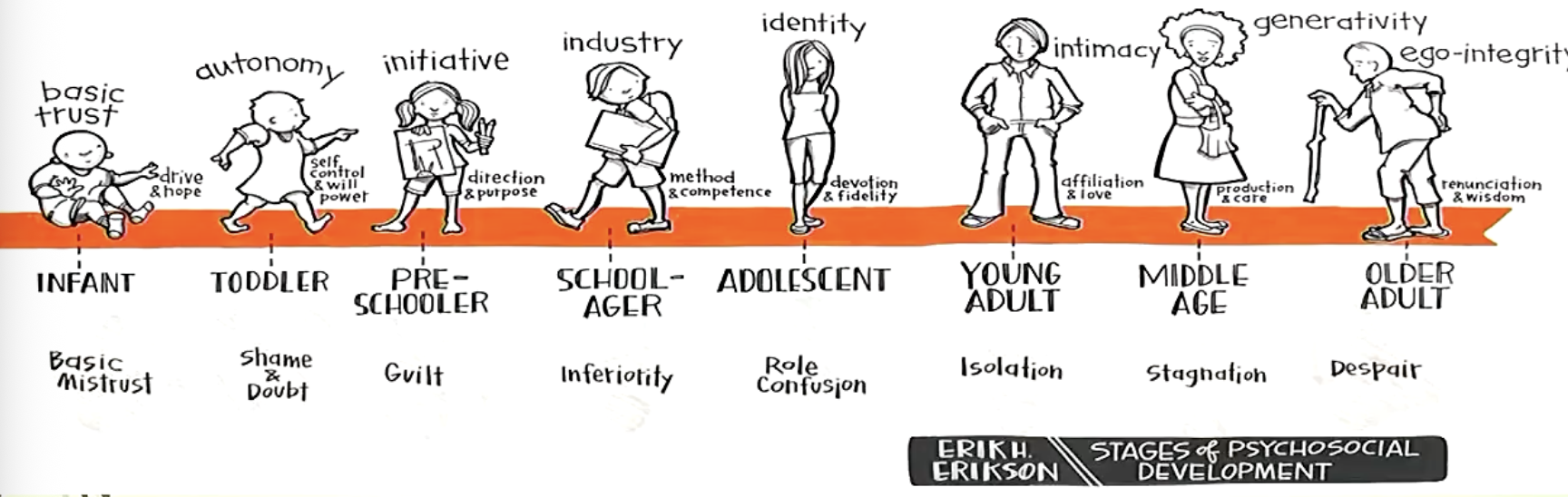
Eriksons model developemnt ove lifespan
this basically talks about how people develop personally and socially. Each stages has its obstacles by which it needs to overcome.
For example support in infancy can lead to beign able to develop trust
Brain development
Different parts of the brain develops at different times and doesnt finish until adulthood.
Integrate neurological changes and development
The brain has critical period where it is especially sensitive to specific experiences. Specific support at specific times is needed for proper development
Application of this: Neurosequential model of theraputics
rather than focus on diagnosis understand behaviour in terms of brain development over time. Stressors can influence development but understanding when it happened can give you a better shot at understanding future psychosocial implications
Timing and adversity is important in considering the effects from a cause.
Hierarchal needs
Each need needs to be met before the next can take place
- Safety
- Movement
- Engagement
- Learning
Consider variables that affect development
Things that are detrimental to development are:
- infections
- antiepileptics
- medications
- Drugs of abuse
- alcohol
- stress and adverse events