Case 1 - 30 minutes
The questions in this case relate to the following paper: R.G Victor et al, (2018) A Cluster-Randomized Trial of Blood-Pressure Reduction in Black Barbershops, New England Journal of Medicine, 37:1291-1301
Part A - 4 minutes
- In your own words, outline the researchers’ rationale for undertaking this randomised controlled trial.
Part B - 4 minutes
- Interim analyses are often conducted by independent researchers in clinical trials. In this paper two interim analyses were conducted. In your own words outline the reasons for conducting interim analyses in clinical trials including this one.
Part C - 4 minutes
The main findings of the study rela;ng to the primary outcome are outlined in the results section of the paper (PRIMARY OUTCOME) and Figure 2.
- In your own words explain the results rela;ng to the primary outcome measure. Your answer should include an interpreta;on of the interven;on effects, rates of progression to cancer, rate difference, confidence intervals and cumulative incidence of progression to cancer.
Part D - 12 minutes
The conclusion in the abstract states that “Among participants with biopsy-proven anal HSIL, the risk of anal cancer was significantly lower with treatment for anal HSIL than with active monitoring.”
- What other results from this trial should be considered before recommending a national screening programme for anal cancer for high risk individuals in Aotearoa/ New Zealand?
Part E - 6 minutes
New Zealand has a national AIDS Epidemiology Group to “monitor the epidemic of HIV/AIDS in New Zealand through ongoing surveillance”. 6. 1. Why is it important to undertake surveillance of HIV/AIDS infection in New Zealand? 2. What public health and healthcare services might use the information collected by the AIDS Epidemiology Group?
Case 2 - 30 minutes
Mr David Lewis is a 62 year old NZ-European male who works as an accountant. He visited his general practitioner (GP) today having experienced some chest discomfort after he had to rush to catch a bus. The discomfort lasted about 10 minutes, during which time he felt lightheaded and breathless.
Mr Lewis reports that he has had a couple of similar, but much less severe episodes over the last few months. He had previously put these bouts of being breathless and dizzy down to just being “really unfit”, because they had come on when he was rushing around or carrying something heavy.
His GP considers that his symptoms are likely secondary to cardiac ischaemia.
Part A - 10 minutes
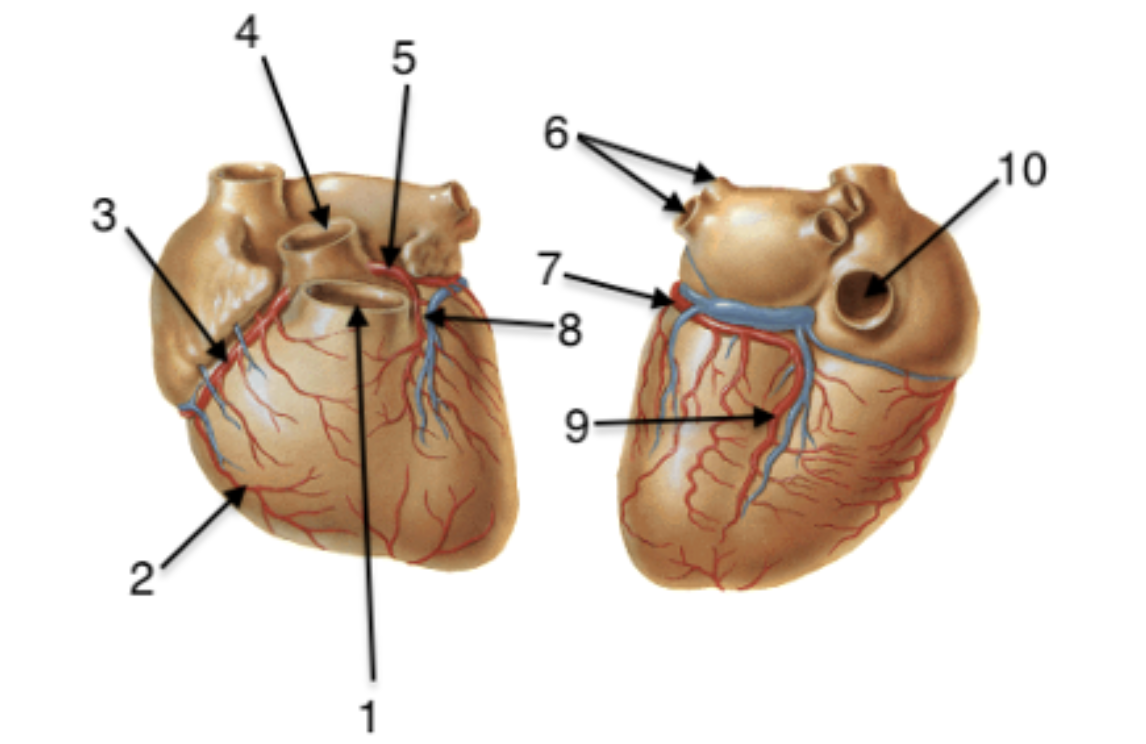
- Label the structures numbered 1-10 in the image of the heart below.
The vessel labelled ‘7’ is accompanied by a venous structure.
-
Where does this venous structure drain into?
-
The autonomic nervous system (ANS) regulates the heart rate.
Where do the nerve fibres of the ANS come from and how do each of these systems affect the heart rate?
-
Why is cardiac muscle pain often felt in the arm?
Part B - 10 minutes
Chest pain arising from myocardial ischaemia (as in Mr. Lewis’ angina) arises from a mismatch between myocardial blood supply (via coronary artery blood flow) and metabolic demands.
Outline the mechanism(s) by which coronary artery blood flow is normally regulated so that oxygen delivery can match changes in myocardial demand.
-
An ECG would have been recorded as part of the investigation of Mr. Lewis’ chest pain. This records the electrical activity of the heart which arises from spontaneous “pacemaker” potentials.
Describe the pathway by which these “pacemaker” potentials spread through the myocardium. You should name the important structures in this pathway and indicate how conduction velocity varies in different parts of the pathway.
Part C - 10 minutes
Mr. Lewis confirms that his chest symptoms presented on exertion. On examination, his BP is raised (160 / 98 mmHg). After careful assessment and exclusion of various differential diagnoses, Mr. Lewis is considered to have stable angina. Mr Lewis is therefore prescribed a sublingual glyceryl trinitrate (GTN) spray, which he is required to take when needed. An ACE inhibitor (cilazapril) is co-prescribed.
-
Describe the mechanism of ac;on and expected therapeu;c effect of GTN in angina. Briefly explain why it is administered through a sub-lingual route.
-
Why would cilazapril be advocated in angina? Explain your response in terms of the mechanis;c impact of this drug on noradrenaline output, and on vascular, and myocardial ;ssues.
Case 3 - 40 minutes
George Te Rangi is an 87 year old Māori tane who lives at home with his wife. Mr Te Rangi had been experiencing some difficulty in breathing and had lost his appetite, so his wife and his son have encouraged him to see a doctor. He has come into the GP practice today with his son, Joshua.
You are a locum GP and this is your first time meeting Mr Te Rangi. You use the Hui process in your interaction with Mr. Te Rangi and his son.
Part A - 10 minutes
-
Name and briefly describe the purpose of each of the FOUR (4) phases of the Hui Process.
-
Describe why it is important to pronounce the names of pa;ents correctly.
Part B - 10 minutes
Mr. Te Rangi’s history and physical examinations findings were suggestive of a pneumonia. He was febrile and his GP arranged for him to be admitted to hospital. Blood and sputum samples were collected.
As part of Mr. Te Rangi’s work up an arterial blood gas (ABG) analysis is done and the results were:
| Arterial blood gas (on air) | Reference Range | |
|---|---|---|
| PaO2 | 60 mmHg | 85 - 100 mmHg |
| PaCO2 | 52 mmHg | 37 - 43 mmHg |
| pH | 7.29 | 7.35 - 7.45 |
| HCO3 | 24 mmol/l | 24 - 30 mmol/l |
The ABG indicates that Mr. Te Rangi is hypoxaemic.
-
Use the ABG results to identify/rule out the possible cause(s) of his hypoxaemia. Justify your answer.
-
The examination showed Mr Te Rangi’s respiratory rate to be 26 breaths/minute. Comment on his ventilatory status.
-
Mr Te Rangi has a haemoglobin concentration of 135 g/L. Estimate his arterial blood oxygen content.
Part C - 10 minutes
-
Describe the dual blood circulation of the lung.
-
List the layers that make up the respiratory membrane.
-
State TWO (2) differences between terminal bronchioles and respiratory bronchioles.
-
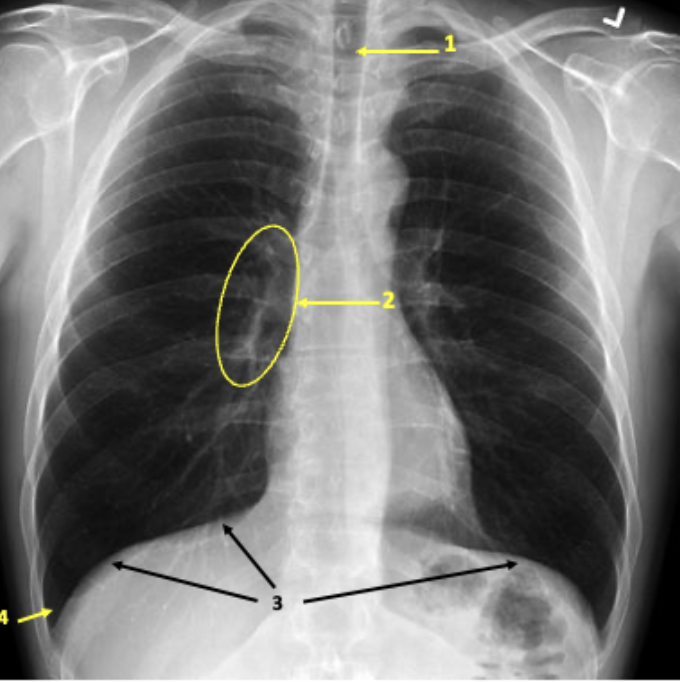
Label the structures in the following image of a normal chest radiograph.
Part D - 10 minutes
Subsequently, Mr Te Rangi’s fever progressed (39.1˚C), and he additionally developed dysponea and a productive cough with copious yellow sputum. Blood cultures, and a further sputum culture were collected; and a chest radiograph was taken which showed areas of consolidation (shown below).
- Briefly describe the type of laboratory tests that would routinely be performed on Mr. Te Rangi’s sputum to determine the infecting microbe.
- Why were blood cultures taken?
Laboratory testing revealed an abundance of encapsulated small Gram negative coccobacilli in Mr. Te Rangi’s sputum (shown below).
A clinical diagnosis of bronchopneumonia was made.
-
Which antibiotic would you choose to treat Mr. Te Rangi’s bronchopneumonia
-
During therapy, Mr. Te Rangi developed severe antibiotic-associated diarrhoea. Briefly comment on the mechanisms behind this adverse response to the antibiotic therapy.
Case 4 - 20 minutes
Mrs Shepherd is a 63 year old NZ-European female who consults her GP complaining of fatigue and shortness of breath on exertion. Tests show her to be anaemic.
After further investigation she is found to have a carcinoma in her ascending colon. She is admitted to hospital and a right hemicolectomy is performed.
A right hemicolectomy is a procedure that involves removing the bowel from the terminal ileum to the first third of the transverse colon, along with fat and lymph nodes.
Part A - 10 minutes
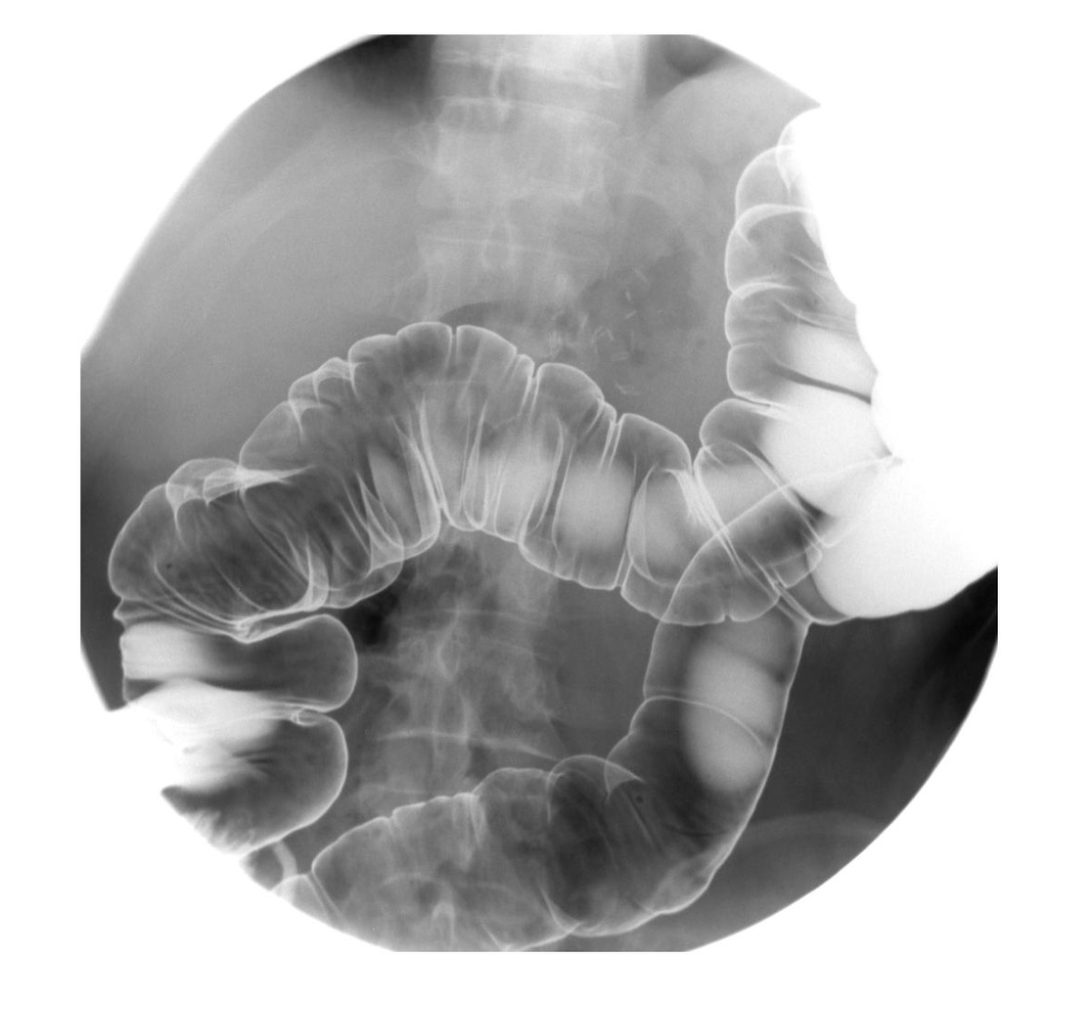
As part of her investigation she has a double contrast barium enema, a normal example of which is shown here.
-
What normal anatomical feature of the gastrointestinal tract is demonstrated clearly on this image? What causes this appearance?
-
A right hemicolectomy is a procedure that involves removing the bowel from the terminal ileum to the first third of the transverse colon, along with fat and lymph nodes. Which anatomical features demarcate the start and end of the ASCENDING colon?
-
The blood supply to the colon is a key component of this surgery. Describe and order the blood supply (both arterial and venous) of the ascending colon which the surgeon will need to be mindful of.
-
The lymphatic drainage of the colon is a key component in the staging of the cancer, and the surgeon will take this into account during the surgery. Describe the lymphatic drainage of the ascending colon.
-
Which embryological feature facilitates relative ease of mobilising the ascending colon.
Part B - 10 minutes
-
What are the normal physiological functions of the large bowel/colon?
-
What motility patterns are normally seen in the large bowel/colon?
-
What other physiological problem might arise if part of the terminal ileum was also removed?