Case 2 – 10 minutes
Part A - 10 minutes
You have a friend’s 21st birthday in Auckland coming up that you want to attend. You book some cheap flights in advance to leave Dunedin on Friday afternoon, and come back on Monday night so you can have some extra time to catch up with friends and family over the weekend. However nearer the time, you learn that you have a home visit booked for Monday morning with two other students, and you are required to report back on the visit in next week’s tutorial.
-
What should you do?
Rank the following options from best to worst (drag and drop them into place).
- Rebook your return flight to Monday morning and risk being delayed
- Call in sick on Monday morning and tell your tutor you couldn’t go to the visit because you were sick
- Ask ELM administrators to reschedule the visit for you and the other students in your group
- Change your return flight to come back on Sunday afternoon at an extra cost of $100
- Join another group of three students for their home visit on another day
- Tell your colleagues you won’t be there and ask them to share their notes with you for the presentation
- Provide a detailed rationale for your choices of ranking.
Case 3 – 30 minutes
Nina McLeod, a 65 year old woman of Pacific Island descent, slips in the shower and stretches out her arm to break her fall. She is worried that she might have fractured her arm and presents to the Emergency Department.
On examination, there was pain on palpation of the humeral greater tuberosity with marked swelling. She has limited abduction of the shoulder joint with a sensory loss over the shoulder joint area. X-ray showed a fracture at the surgical neck of the humerus.
Part A - 10 minutes
-
Name the neural and vascular structures that have been likely affected in this patient. radial nerve and profunda brachii artery
-
Name the muscles innervated by the nerve damaged in this patient. extensor carpi ulnaris branchioradialis anconeus extensor carpi radialis longus extensor carpi radialis brevis extensor digitorum extensor digiti minimi
supinator extensori indicis extensor pollicis longus extensor pollicin brevis abductor pollicis longus
-
Name the muscle that is involved in the initial abduction of the shoulder joint. deltoid
-
Indicate the spinal root levels of the following nerves of the brachial plexus and the muscle groups that may be affected if these nerves are damaged at the wrist.
Part B - 5 minutes
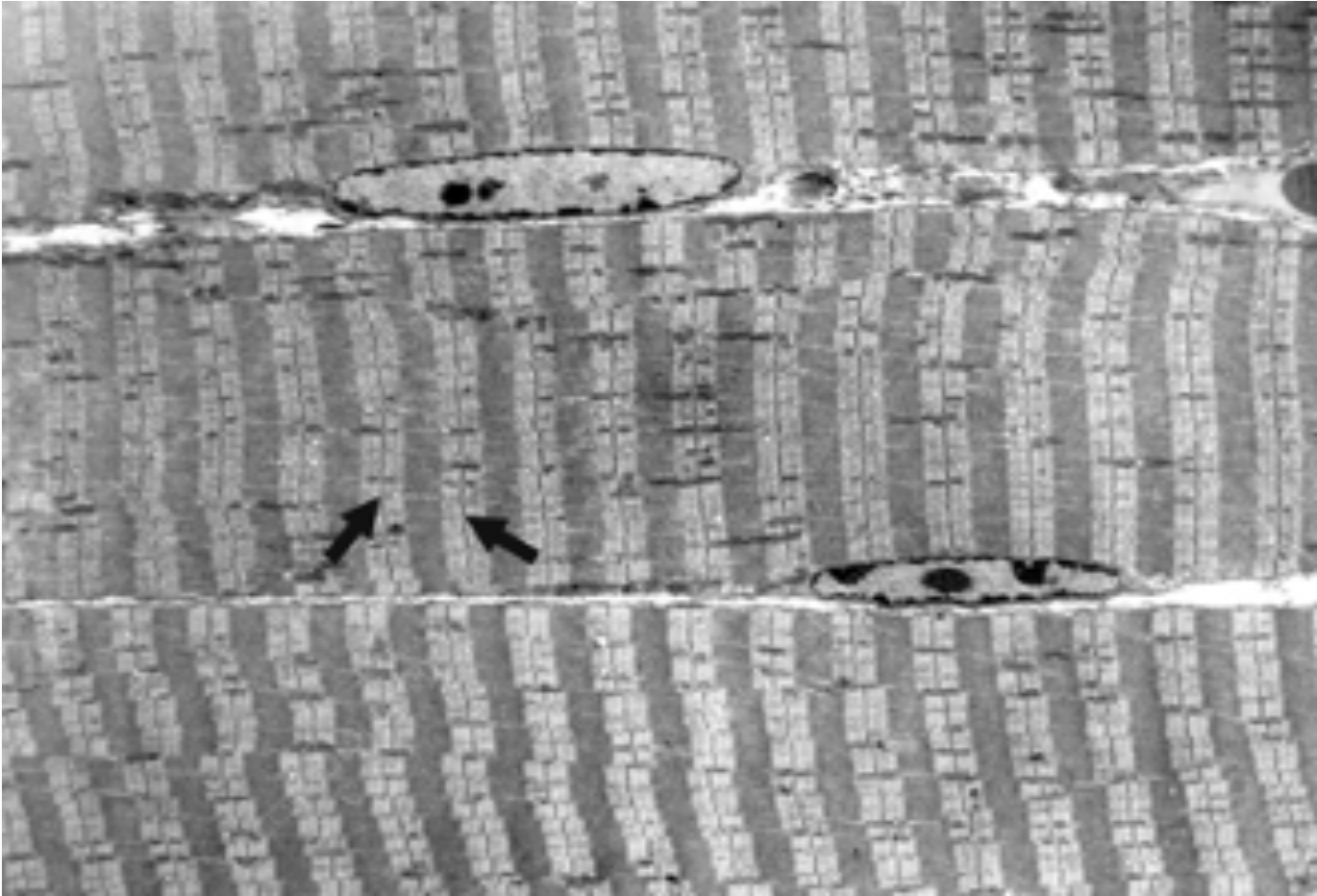
This is a transmission electron micrograph of a muscle biopsy.
-
What type of muscle is shown in the above micrograph? striated due to the i and a bands
-
Give TWO (2) reasons for your identification above. due to the i and a bands peripheral nuclei
-
Name the contractile unit that lies between the two dark lines indicated by the black arrows. sarcomere
-
Which bands/zones get shortened when a muscle contracts? the h and i bands that shorten
Part C - 5 minutes
Mrs. McLeod has pain issues following the injury.
- Briefly describe the 3 distinct classifications of pain.
nociceptive this is where your nerve sense a destructive stimulus
neurological this is where nerve lesions cause pain
nociplastic this is where there is extended pain response from remodeling which moves the pain threshold
Part D - 10 minutes
Surgery is discussed with Mrs McLeod as an option for managing her fractured humerus. She is reluctant to undergo surgery.
As the attending doctor, you want to explore the reasons behind this reluctance to undergo surgery, and you use the Fonofale model to guide your questioning
-
List any four (4) components of the Fonofale model that could assist you with your questions. physical, mental, spiritual, cultur
-
For each component (4), write a question that you could ask to help you gain a better understanding of Mrs. McLeod’s situation. Is there any physical thing that oyu are worried about why do you feel reluctant is there anything spiritual about this that makes you reluctant is there related to your family that makes you reluctant.