Case 1 - 21 minutes.
Part A - 4 minutes
Question 1: In your own words, outline the researchers’ rationale for undertaking this randomised controlled trial.
Part B - 4 minutes
**Question 2:**The last paragraph of the methods section (page 2249) states that: “The treatment policy estimand (the primary estimand used in all statistical testing) was used to assess treatment efficacy in the full analysis population, regardless of adherence to the assigned regimen… (emphasis added)” What is this approach to analysis called, and why is it important to undertake this type of analysis in a randomised controlled trial?
Part C - 4 minutes
**Question 3:**The main findings of the study relating to the primary outcome are outlined in the results section of the paper and Table 2. In your own words explain the results relating to the primary outcome measure. Your answer should include an interpretation of the intervention effects, and confidence intervals.
Part D - 4 minutes
**Question 4:**A recent Cochrane systematic review and meta-analysis examined the effectiveness of drug interventions for the treatment of obesity in children and adolescents. The results of meta-analysis for the primary outcome (change in Body Mass Index or BMI) appears below.
Explain the result of the summary measure, commenting on the point estimate and 95% confidence interval.
Part E - 5 minutes
**Question 5:**The papers described above (both the meta-analysis and Weghuber et al) relate to an individual level intervention for obesity.
For addressing obesity:
- Briefly describe an evidence based population level approach that could be applied, outline how it could be effective among adolescents in Aotearoa New Zealand.
Case 2 - 80 minutes
You are an ALM student attached to a House Officer on their Emergency Department (ED) run. There has been a motor vehicle accident (MVA) and the ED is expecting 2 patients.
The first patient who comes in, by ambulance, is Petra Mahoney, a 46-year-old New Zealand European female.
Petra was driving through an intersection when she ran into the vehicle being driven by Sandy Reyes. Petra sustained only minor injuries in the accident. As she left the scene in the ambulance, she could see a number of emergency services workers busy looking after Sandy.
Later tests found her blood alcohol level was well over the legal limit for driving. The Police have since charged Petra with drunk driving and suspended her driver’s licence for 28 days.
Petra is a family court lawyer in a local law firm and has been under a lot of pressure lately. She regularly joins her colleagues for drinks after work, and she continues drinking when she gets home as it helps her ‘relax and unwind’. She is aware that she probably drinks too much, but it has not caused any problems until now. She is worried about what her colleagues will say and the impact of a criminal conviction on her work.
Question 1: Primary prevention addresses the risk factors associated with the use of alcohol and other drugs (AOD) and strengthens protective factors through public education, legislation and policies. Describe, briefly, FOUR (4) examples of primary prevention.
Part B - 10 minutes
Question 6: There are two main approaches used in the management of addictions. These include the harm minimisation and the disease/recovery models. Describe each management approach and provide an example of a community agency for each one.
Part C - 10 minutes
Question 7:
- Identify Petra’s stage of change
and
discuss what recommendations you would make based on her stage of change.- What support services would you suggest for Petra?
- What barriers might prevent Petra from accessing support to reduce her alcohol intake?
Part D - 10 minutes
The second patient from the motor vehicle accident is 30-year-old Filipino male, Sandy Reyes. Sandy was driving across an intersection, when another driver ran a red light and collided with the driver’s side of Sandy’s vehicle. The side of Sandy’s vehicle was badly crushed and it took some time for the emergency services to extract Sandy from the vehicle. When the paramedic staff were able to assess Sandy they found he was pale, diaphoretic, and tachycardic. As well as numerous cuts and scratches, he had an obvious deformity of his right arm just below the shoulder. When his shirt was cut away, a broken bone from his upper arm was seen protruding through his skin. There was significant bleeding from his arm. Sandy’s arm was bandaged, he was given pain relief at the accident site and additional analgesia in the ambulance on the way to the ED. On arrival at ED, Sandy complains of severe pain when he tries to move his right arm. An x-ray of Sandy’s deformed right arm shows a compound mid-shaft fracture of the humerus. While operating theatre space was being organised, the ambulance bandaging was reinforced with the addition of a back slab (a plaster of paris board applied to a limb with bandages) to minimise movement of the fracture. With ongoing bleeding from his multiple injuries there is a risk that Sandy’s blood pressure will fall significantly.
Question 8: Briefly outline the mechanisms by which baroreceptor reflexes will act to prevent Sandy’s blood pressure from dropping in the short term.
Question 9: What is Starling’s Equilibrium and how will it help Sandy to maintain his blood pressure?
Part E - 7 minutes
Sandy has a mid-shaft fracture of his humerus.
Question 10: Which vascular structure is likely to have been damaged along with the fracture of Sandy’s humerus?
Question 11: Humeral mid-shaft fractures typically involve what nerve?
Damage of this nerve impairs what movement at the wrist joint?
Question 12: What effect(s) will damage to the nerve above have on movement at the elbow joint? Give a reason for your answer.
Part F - 8 minutes
Use the x-ray of the elbow joint below to answer the next FIVE (5) questions.
**Question 13:**Concentric contraction of the muscles attached at the bony prominence ‘A’ in the radiograph will produce what movements at the wrist joint?
Question 14: Which nerve passes posterior to the bony prominence labelled A?
Question 15: Damage to the nerve posterior to the bony prominence labelled A will affect which muscles?
Question 16: What is the name of the muscle attached to the bony prominence labelled B and what are its proximal attachments?
Question 17:
- What is the nerve supply to the muscle attached to the bony prominence labelled B?
- From which cord of the brachial plexus does this nerve arise?
- What are the spinal nerve root levels of this nerve?
Part G - 5 minutes
Below is a microscope image of normal bone. Use the image to answer the next FIVE (5) questions.
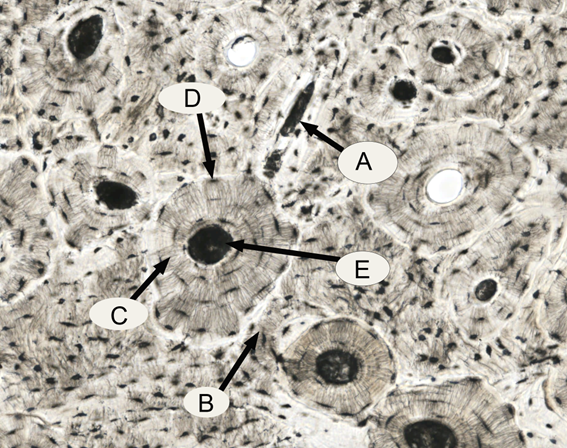
Question 18: Name and describe the function of the channel labelled A in the above image.
Question 19: What is the name given to the main matrix labelled B?
Question 20: Name and describe the function of the channels labelled C.
Question 21: Name the type of bone cells that reside in the space labelled D.
Question 22: Name the type of bone cells that are found in the lining of the canal labelled E.
Part H - 10 minutes
In the operating theatre, Sandy has an open reduction with internal fixation (the bones are held in place with metal plates and screws) to repair his fracture.
After the procedure, the surgeon remarks that there was more bleeding than anticipated during the surgery and that the bleeding was difficult to control.
Question 23: Outline how bleeding from tissues is controlled by normal haemostatic mechanisms.
Question 24: Indicate the importance of each of the haemostatic mechanisms for controlling bleeding.
Question 25: Suggest three reasons why the bleeding might have been heavier than usual.
Part I - 10 minutes
Sandy recovers well and is discharged with a plan for outpatient follow-up and rehabilitation.
Three months following discharge
Sandy again presents to ED. He reports that for the last two weeks he has had pain in his right arm at the site of the surgery.The interpretation of an MRI (magnetic resonance image) suggests infection around the metalware in his right arm. Sandy is returned to theatre and a sample of bone adjacent to one of the screws is sent to the laboratory.
A Gram stain is performed on the obtained sample (figure below).
Figure: Gram stain of the sample taken from Sandy.
The sample is also plated onto various agars including blood agar. A yellowish, beta-haemolytic colony is isolated on the blood agar plate following 18 hours of incubation. Subsequent testing demonstrates the isolate is catalase positive and coagulase positive.
Question 27: Describe the Gram stain in the figure above.
Question 28: What presumptive identification can be made on the basis of the microbiological investigations? Provide reasons to support your identification.
Question 29: Susceptibility testing shows that the organism is resistant to methicillin (a beta-lactam antibiotic).
What is the mechanism of action of beta-lactams?
What is the likely mechanism of resistance in this case?
Question 30: What alternative antibiotic could be used and what is its mechanism of action?
Question 31: Other than antibiotics, how else should the infection be treated?
Case 3 - 35 minutes
Mr Danny Choudhary, a 60-year-old Fijian male, visits his GP because he has developed a sore on the hallux (big toe) of his right foot that isn’t healing. He also reports experiencing calf cramps in the same leg when walking a block to the shops. Mr Choudhary is a smoker and has a BMI of 32.
Part A - 10 minutes’
Question 32: Starting at the external iliac artery, name, in order, the vessels that supply the foot.
Question 33: Mr Choudhary comments that his foot pain often gets worse at night when he is in bed. He finds that he gains relief by getting up or hanging his leg out the side of the bed.
Why does this relieve the foot pain?
Part B - 15 minutes
A blood screen conducted following Mr Choudhary’s visit to his GP showed a TC:HDL ratio of 6.2. His GP starts him on atorvastatin at 40 mg once daily.
Question 34: Discuss the mechanism of action of atorvastatin. What significant adverse effects should Mr Choudhary be cautioned of when taking this drug? How may these occur with this drug class?
Question 35: Mr Choudhary’s GP remains concerned about his patient’s LDL levels which remain high even after increasing the dose of atorvastatin to 80 mg once daily.
Name and describe the mechanisms of action of other pharmacological treatments that may be used to improve the lipid index in a patient already taking high doses of statins.
Part C - 10 minutes
Mr Choudhary’s circle of close friends is limited, comprising of individuals who all smoke, are heavy drinkers, and enjoy social gatherings centred around BBQs on weekends.
Question 36: If Mr Choudhary’s condition remains unmanaged, he may be at risk of toe amputation. Identify THREE (3) potential barriers hindering the patient from altering his behaviour regarding smoking?
Question 37: According to the transtheoretical model of stages of change:
- Identify the current stage that Mr Choudhary is in and provide a rationale for your selection.
THEN- Indicate the stage after the stage Mr Choudhary is currently in, and provide a rationale for why Mr Choudhary is not currently in this stage.
Question 38: Excluding smoking cessation and directly targeting a healthy BMI, What are THREE (3) additional healthy lifestyle practices that Mr Choudhary can adopt to further minimize complications of his chronic disease and enhance his overall wellbeing?
Case 4 - 20 minutes
Elisha is a 7-year-old girl whose parents are concerned about aspects of her development.
Elisha’s parents report that she has never had any friendships at her early childhood centre nor at school. She has been invited to several birthday parties but spends her time at them playing on her own and does not respond to invitations to join in group activities. Elisha took longer than other children to talk, and her parents did not know if she understood them as they have always had trouble getting her to look at them when they talk to her. Her parents noted that they have difficulty knowing how she is feeling as she does not display overt signs of emotion.
Part A - 10 mins
Question 39:
- Identify the THREE (3) domains of Takiwatanga/Autism Spectrum Disorder (ASD) symptomatology,
AND- Categorise the features of Elisha’s behaviour or development that are consistent with ASD symptoms in the relevant domains.
Question 40: What other symptoms and/or information would you be looking for, in order to be confident that Elisha meets diagnostic criteria for ASD?
Part B - 10 minutes
Elise’s father brings her to a general practice clinic for a COVID-19 vaccination.
Elise becomes very distressed when she sees the needle and refuses to be still for the injection. Her father and the nurse attempt to calm Elise by speaking to and comforting her, but Elise remains very agitated, and writhes and screams whenever the GP holds the syringe.
The father insists that Elise needs to be vaccinated, and asks if there is a medication that could be used to calm Elise down.
Question 41: Would it be ethically appropriate for the GP to use a sedative to calm Elise so that she can be vaccinated?
Justify and explain your answer with reference to at least two ethical concepts.
Case 5 - 8 minutes ???
Three important conditions that can cause jaundice are:
- haemolysis (assume there are no complications such as pigment stones)
- acute hepatitis
- cholestasis (either intrahepatic or extrahepatic)
Question 42: For each of these three conditions, decide whether each of the following statements is True or False with regard to the underlying condition (i.e., not as an independent finding). There may be any number of true statements for each condition (from none to all) and the same statements may be true for more than one condition.
Consider each statement independently of each of the other statements.
For your answers, assume that each condition is at a fully developed stage unless stated otherwise.
| Statement | Haemolysis | Acute hepatitis | Cholestasis | |
|---|---|---|---|---|
| 1 | The patient’s prothrombin time may well be longer than the upper limit of the reference interval. | Answer 1 Question 60 TrueFalse | Answer 2 Question 60 TrueFalse | Answer 3 Question 60 TrueFalse |
| 2 | The patient’s serum albumin concentration should be within the reference interval. | Answer 4 Question 60 TrueFalse | Answer 5 Question 60 TrueFalse | Answer 6 Question 60 TrueFalse |
| 3 | The patient’s 24 hour output of urine urobilinogen will consistently be above the upper limit of the reference interval. | Answer 7 Question 60 TrueFalse | Answer 8 Question 60 TrueFalse | Answer 9 Question 60 TrueFalse |
| 4 | The patient’s plasma activity of alkaline phosphatase (ALP) will be within the reference interval. | Answer 10 Question 60 TrueFalse | Answer 11 Question 60 TrueFalse | Answer 12 Question 60 TrueFalse |