Case 1 - 85 minutes
Ana Roberts, an 82-year-old Māori female is admitted to the hospital after suffering a fall at home. She reportedly slipped and landed on her right hip, resulting in a fractured femur. On examination, she presents with significant pain and swelling in her right thigh. X-rays confirm a fracture of the right femoral neck.
Case 1
Part A - 15 minutes
You are an ALM student working with the house surgeon and you are asked to take a history from Mrs Roberts and her daughter. It is the first time that you have met them and you use the Hui Process to guide the interaction.
Question 1: Name and describe the FOUR stages of the Hui Process.
mihimihi - this is the greeting whakawhanaungatanga - this is making connections and understanding each others place in the world kaupapa - this is the foundation of the visit- history and examinations occur here poroporoaki- this is summarisaitons, next steps, and farewell
Question 2: Provide ONE (1) sentence that you could say to Mrs Roberts and her daughter that uses or illustrates the principle underlying EACH of the FIRST TWO stages of the Hui Process.
Kia ora, Ko Jasper finney toku ingoa, no poneke ahau, ko ngati kahunguno toku iwi.
Question 3: Outline THREE (3) reasons the final stage of the Hui Process is important.
Closure allows all the parties to reliably move on to next steps and understang what is happening and what needs to be done next. failure can lead to dis jointed comminucation and dissatisfaction with the healthcare system
Part B - 20 minutes
Question 4: Recalling that Ana Roberts is an 82-year-old female: Name and discuss the pathophysiology of TWO (2) conditions that could cause Mrs Roberts to:
- Experience a collapse (i.e. a sudden and unannounced loss of postural tone [going weak], often, but not necessarily accompanied by a loss of consciousness).
- Sustain a fractured femur.
valvular heart disease can lead to collapse as the perfusion requirements of the body outpace what can be supplied by the heart
fractured femur can be from osteoporosis found in postmenopausal women
Question 5: Mrs Roberts is noted to have swelling in her lower calves and feet (both legs) as well as swelling in her right thigh. Compare and contrast the potential pathophysiological mechanisms for the bilateral calf/feet swelling versus the swelling in the right thigh.
commonly bilateral calf and foot swelling is common in peripheral oedema, common in right heart failure. This is because higher venous pressure doesnt allow water in the interstitial space to reenter plasma, disrupting the starling equilibrium and leading to net increase of volumein peripheries. as venous bp is highest in the lowest part of body (hydrostatic column like effect) thisis where effects are most pronounced.
right thing indicates a unilateral effect so possibly a thrombus and infarct as it isnt the lowest part.
Case 1. Part C - 10 minutes
This is new information.
When the house surgeon obtains a history from Mrs Roberts and her daughter, they learns that Mrs Roberts was diagnosed with rheumatoid arthritis (RA) in her forties and had been on oral steroids and other non-steroidal anti-inflammatory drugs (NSAIDs) before commencing on methotrexate.
Ana’s daughter also reports that her mother has been experiencing some dizzy spells, has a productive cough and recently has developed some shortness of breath on exertion.
The surgical team discuss options with Mrs Roberts and her daughter, and decide that she will undergo a hip arthroplasty (hip replacement).
Question 6: Describe the mechanism of action (MOA) of methotrexate in the treatment of RA.
it is a folate antagonist which leads to fast reproducing cells being slowed in reproduction and it also leads to an accumulation of adenosine which is an immunosuppressant. both inhibit the immune system
How does the MOA of methotrexate differ from the MOA of NSAIDs in the treatment of RA?
Nsaids block cox from making prostaglandins and act to suppress inflammation that way. Methotrexate leads to accumulation of adenosine
Recalling that Mrs Roberts is 82 years old, has a fractured femur, and is facing a major surgical intervention:
What are THREE (3) side effects of methotrexate that the healthcare team needs to pay particular attention to?
reduced healing immunosupression hepatic toxicity interacting with anaethesia
What TWO (2) precautions should be taken when administering methotrexate to Mrs Roberts at this time?
Standard precautions consent
Case 1. Part D - 15 minutes
Below is a photograph of the bones of a normal hip. Use the photograph to answer the following FIVE (5) questions.
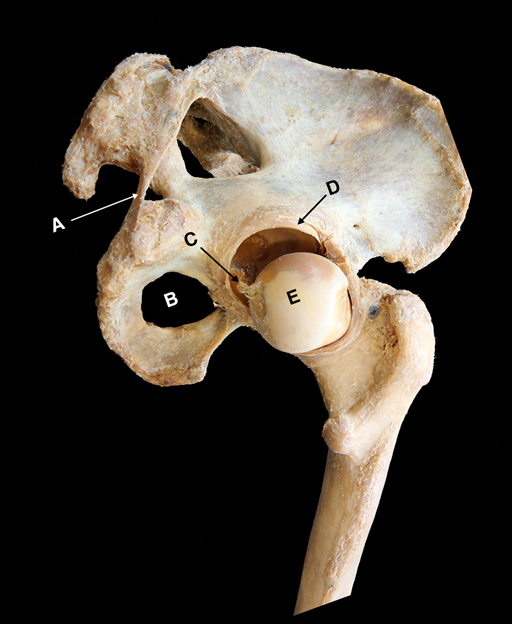
Name A-E in the photograph above of the normal hip joint.
- Sacrotuberous ligament
- obturator foraman
- ligament of the head of the femur
- acetabular labrum
- head of femur
Discuss the significance of structure labelled C in a young child.
this is important for growth as it makes sure the hip joint is well supplied
Describe the histological make up of the structure labelled D.
this is hyaline cartilage
The hip joint is surrounded by a fibrous capsule.
Describe the attachment of the fibrous capsule.
the ileofemoral ischiofemoral pubofemoral
Recalling that the surgical team discussed options with Mrs Roberts and decided that she will undergo a hip replacement.
The fracture was intracapsular as shown in the x-ray below.Discuss:
- the implications of a fracture of the femoral neck at the hip joint,
- the consequences of this fracture when considering management and healing of the joint. Include in your discussion reasons why the surgeon decided to carry out a hip replacement rather than internal fixation.
hip joint fracture is serious and can lead to death soon ???
Case 1. Part E - 15 minutes
During her post-operative recovery, Mrs Roberts develops respiratory distress and her haemoglobin saturation decreases.
An arterial blood gas (ABG) sample was taken and as the results below indicate she is hypoxaemic.
| Arterial blood gas (on air) | Reference Interval | |
|---|---|---|
| PaO2 | 60 mmHg | 85 – 100 mmHg |
| PaCO2 | 55 mmHg | 37 – 43 mmHg |
| pH | 7.26 | 7.35 – 7.45 |
| HCO3 | 24 mmol/L | 24– 30 mmol/L |
Use the ABG results to identify/rule out the possible cause(s) of Mrs Robert’s hypoxaemia. Justify your answer.
5 causes of hypoxaemia
- Atmosphere
- ventilation
- diffusion
- V/q mismatch
- shunt
It cannot be atmosphere as she is breathing room air. We also see CO2 decrease so it cannot be diffusion.
it could wither be ventilation v/q mismatch or shunt
What acid-base abnormality does the ABG indicate? shes has hyperacidaemia due to retained co2
How did this occur? shes retainging co2 dut ot poor ventilation, v/q mismatch or there being shit in her lungs
Estimate Mrs Robert’s arterial blood O2 content if her haemoglobin concentration is 120 g/L.
150 - 200
160 mmol/l?
Case 1
Part F - 10 minutes
Mrs Roberts has a 54 year old daughter, Ms Black.
Ms Black is Mrs Roberts’ main support. Ms Black works as a manager in the retail industry. She is married and has two adult children who no longer live at home. Ms Black enjoys her work, has generally had good health with no previously known medical conditions. She is a keen walker and regularly walks 30-40 minutes at least four times a week.
Two months ago, whilst Ms Black was getting ready to go to work, she experienced an unexpected and unpleasant intense feeling of fear during which her heart was racing, she felt dizzy and unsteady on her feet, she had chest discomfort and felt that she had difficulty breathing. She was concerned that she was going to collapse and thought “I am going to die”. The episode lasted for about 10 minutes and then resided completely. She didn’t tell her husband about the episode as she thought maybe she had imagined it. However, over the following month, Ms Black experienced 4 or 5 more of these episodes. They were all very similar in that they would come on suddenly and unexpectedly, her heart would race, she would feel short of breath, felt dizzy, she felt like she would collapse and die, and then the intense feelings would resolve after a few minutes. She tried to work out what was causing the episodes so as to try and stop them from occurring but there seemed no pattern as to when they would happen (e.g. they could occur at home or at work and could occur when she was relaxing and watching television).
Ms Black had begun to worry about these attacks and having more of them. She eventually talked to her husband about what was happening to her and said she felt like maybe she was “going crazy”. She had also stopped going on her walks because walking triggered an increased heart rate and increased breathing rate and she was worried that the walking would trigger another episode of feeling like she was going to collapse.
Ms Black went to her GP and was cleared of any medical condition that could be causing the symptoms.
Name the psychological diagnosis that would best explain Ms Black’s presenting symptoms?
Panic attack disorder
What are the key diagnostic symptoms or behaviours, as described in the scenario above, that lead you to think Ms Black meets criteria for the psychological disorder that you gave her?
Multiple experiences that matched a panic attack occuring for a month and unattestable to anything else additionally changing behaviour due to panic attacks
Case 2 - 35 minutes
Ben Haraldsson is a 3-year-old New Zealand European male who presents to his General Practitioner (GP) with a cough and fever. His history is significant for recurrent pneumonia and chronic diarrhoea. His mother states that he has 6-8 foul smelling stools per day.
On examination Ben’s temperature is 38.4°C. He is tachycardic and tachypnoeic. On auscultation of his lungs, he has scattered rhonchi audibly bilaterally. His abdominal examination is significant for a hepatomegaly.
Further investigations reveal elevated sweat chloride testing on two separate occasions.
Case 2
Part A - 10 minutes
Diarrhoea arises from an increase in the volume of water and electrolytes in the lumen of the gastrointestinal tract. Describe the physiological mechanisms of diarrhoea.
- osmotic this is where there is a high persistant osmolarity of gut lumen drawing liquid into it
- secretory this is when a lot of salts are secreted into the lumen, drawing in water
- absorptive This is where there is little absorption to resorb already secreted salts and water
- motile this is when there is so much motility no absorption can happen in time,
Management of diarrhoea often involves oral rehydration fluids. What is the physiological basis behind the composition of oral rehydration fluids?
If you put sugar and salt together in an oral rehydration fluid then the glu na + co transporter can act to add additional water from lumna
Case 2. Part B - 15 minutes
The GP suspects that Ben is affected by a genetic condition and constructs the following family tree:

what inheritance pattern does the suspected genetic condition follow? autosomal recessive
What is the chance that Anna and David will have another affected child? if affected includes carrier then 75%. if affected does not include carrier 25%
Ben’s older sister Alice (aged 6) is healthy and does not suffer from the same condition as her brother.
What is the chance of Alice being a carrier? 66.6%
Explain your answer. there are 4 outcomes. cf carrier carrier not carrier if you exclude cf then 2/3 options are carrier and 1/3rd is not
David’s sister Jane is expecting a child with her Samoan partner Hemi. NOTE: For the purposes of your calculations you should assume that, due to his ancestry, the risk of Hemi being a carrier of the disease affecting his wife’s nephew is insignificant.
What is the chance of them having an affected or carrier child? minimum chance is 25% of being a carrier child
Explain your answer. we know that at least one grandparent must have the gene
this means jane has a 50% change of being a carrier. which means 50% change that her child does too
Many genetic diseases have varying levels of penetrance and expressivity.
In terms of genetics:
- explain these two terms
and - briefly discuss factors that may have an influence on them.
Penetrance is the concept that not all people with the disease associated allele has the phenotype associated with it Expressivity is the concept that people with the disease associ
Many genetic diseases have varying levels of penetrance and expressivity.
Explain whether you believe incomplete penetrance is likely to be observed in Ben’s condition.
Case 2. Part C - 10 minutes
Ben’s condition continues to worsen and he is considered for a lung transplant.
The image below is of a high-resolution CT scan of Ben’s chest
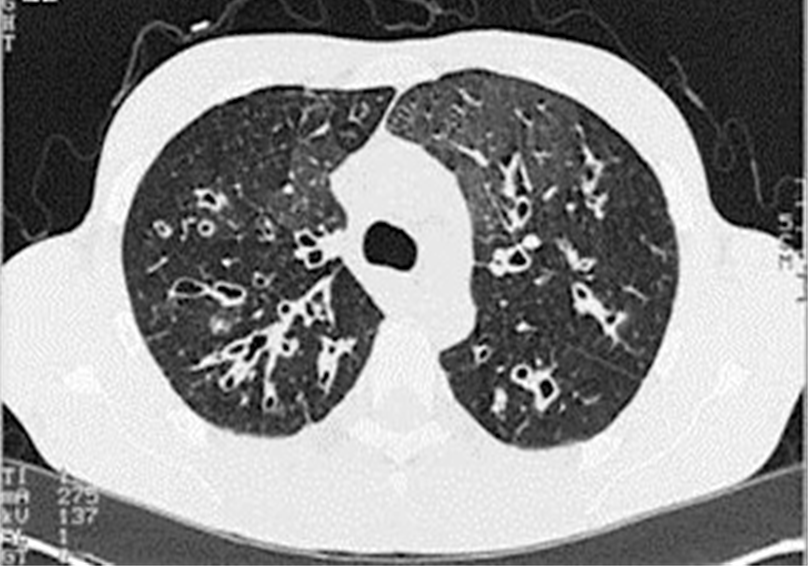
Describe the pathological features present in the image.
there is signigicant emphysematous bullae in the lungs
Ben undergoes a lung transplant.
Below is the photograph of Ben’s lung removed during the transplant.
Describe the pathological features seen in the lung.
Look at the overall appearance, the parenchyma, and the airways.
emphysema and wasting in the lungs
Case 3 - 10 minutes
You meet up with two of your classmates (Ari and James) to travel to a home visit together for EPE. Ari flats with a friend of yours and is in your tutorial group so you know him well and often socialise together. James is from another group so you don’t really know him.
On your way to Ari’s car, Ari admits that he is not enjoying medical school and isn’t sure if it’s for him. He has missed a lot of class and says that has also missed one Terms Requirement. However, he is the first in his family to go to medical school and his parents are encouraging him to stick with it.
As a way of coping, Ari has been partying a lot and is often so hungover that he misses or is late for class. As you are walking to his car, he tells you he had a big night out last night so hasn’t slept much, and you notice that you can still smell the alcohol on him.
James looks at you with a worried expression as Ari is the group’s driver. How should you and respond to Ari?
Rank the following options in order of your preferred response to this situation. (drag and drop them into place)
- Suggest that Ari calls in sick but lets you and James use his vehicle to get to the visit, and suggest he talk things over with the Associate Dean of Student Affairs.
- Suggest that Ari stays home to sleep it off but that you will share information with him about the visit for the tutorial debrief and reflective report.
- Offer to drive so he can stay home and sober up and arrange to meet him later in the day to talk about things.
- Offer to drive since Ari has been drinking.
- Ask if he is ok to drive and get in the car.
- Commiserate about having to get up early after a big night out.
Rationale for: An EPE visit is an extension of the med school and the practice. It is inappropriate and detrimental to the reputation of the school and the practice for Ari to show up inebriated.