Case 1. 25 minutes.
The questions in this case relate to the following paper:
Iwuji CC, Orne-Gliemann J, Larmarange J, Balestre E, Thiebaut R, Tanser F, Okesola N, Makowa T, Dreyer J, Herbst K, McGrath N, Bärnighausen T, Boyer S, De Oliveira T, Rekacewicz C, Bazin B, Newell M-L, Pillay D, Dabis F. Universal test and treat and the HIV epidemic in rural South Africa: a phase 4, open-label, community cluster randomised trial. Lancet HIV 2018; 5: e116-25.
Retrieve the paper and appendix
Part A. 5 minutes.
Question 1 In your own words, outline the researchers’ rationale for undertaking this randomised controlled trial.
Part B. 5 minutes.
Question 2
- Identify ONE (1) source of bias that could occur within this randomised controlled trial.
- For the source of bias that you have identified, explain how this bias may have influenced the result relating to the primary outcome.
Part C. 5 minutes.
Question 3 In your own words explain the results relating to the primary outcome measure. Your answer should include an interpretation of the intervention effects, and confidence intervals.
Part D. 5 minutes.
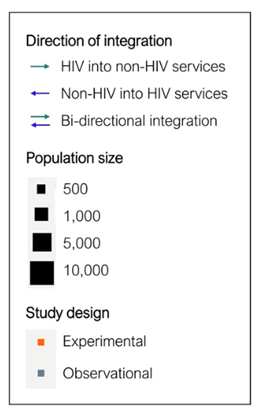
A recent systematic review and meta-analysis examined whether integration of HIV services with other health services could improve antiretroviral therapy (ART) initiation among those who are found to be HIV+. Integration of care can be uni-directional (from HIV to non-HIV services, or from non-HIV services to HIV services), or bi-directional (to and from HIV and non-HIV services). This analysis synthesises studies that compare people who have received an integrated care approach vs those who have not received an integrated care approach. The results of the meta-analysis for the primary outcome ( (A) ART Initiation) appear below.
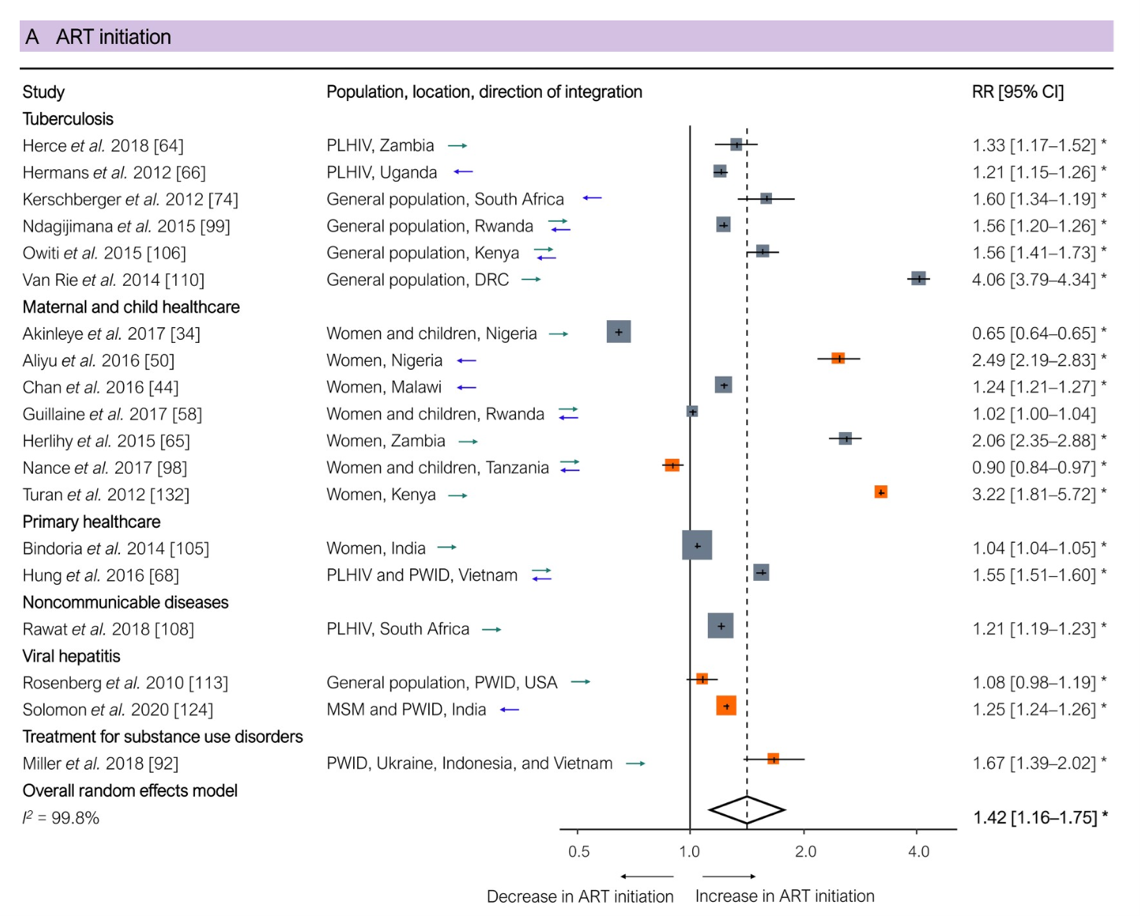

Question 4 Explain the result of the summary measure (“Overall effect”), commenting on the point estimate and 95% confidence interval.
Part E. 5 minutes.
Question 5 In the description of forest plot (Fig 3. Results of integration of HIV services: ART initiation, shown above), the authors state: “Outcomes are related to the ‘second 95’ of the 95-95-95 HIV cascade of care.”
What is meant by this statement?
Case 2. 40 minutes
Sione is a 39 year-old Pacific Islands male. Sione migrated to Aotearoa New Zealand with his family 5 years ago. He works as a teacher. He presented to his GP with a 2-month history of progressive shortness of breath on effort. Physical exertion was often associated with central chest pain and irregular palpitations. Sione also reported that on two occasions in the last month he had woken from sleep with attacks of frightening breathlessness and was unable to lie flat. His general health was good, with no weight loss or anorexia. He said he had no past history of significant health problems apart from a vague memory of being in hospital as a child but did not understand why, “it was something to do with a sore throat”.
Part A. 10 minutes
Question 6 Considering only the heart valves associated with the LEFT side of the heart:
- Name the valves
- Identify the surface anatomy sites for auscultation of the heart sounds associated with these two valves
- Describe the normal gross anatomical structure of both valves.
Part B. 10 minutes.
Sione’s current presentation and past history could indicate cardiac valve dysfunction.
Question 7 With reference to the LEFT side of the heart and starting from the END OF DIASTOLE, describe the sequence of valve movements through a complete cardiac cycle. You should indicate:
- which valves move and when,
- what pressure differences cause each valve movement, and
- any associated heart sounds.
Question 8 Cardiac valve problems can eventually lead to heart failure, features of which include breathlessness and peripheral oedema. Briefly outline the processes that cause breathlessness and peripheral oedema in heart failure.
Case 3, 35 mins
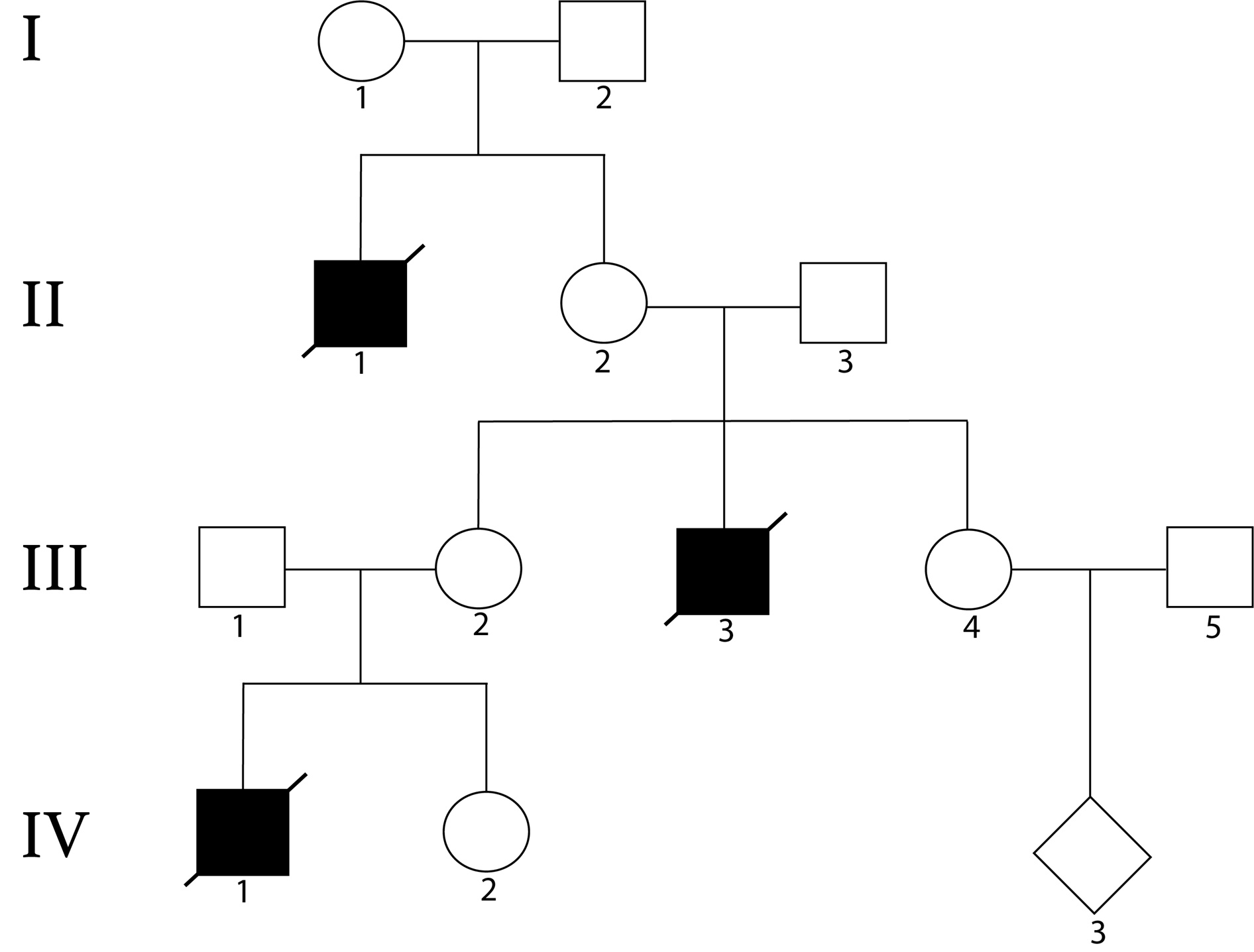
Heather is a 26 year-old Pākehā female. In the pedigree below she is individual III:2. She presents with questions regarding her family history of severe global developmental delay and congenital heart disease in three male members of her family.
All three males are deceased because of this condition and no blood or DNA samples have been stored that can be analysed.
The deceased males are Heather’s:
- son (IV:1) died at 4 years of age.
- brother (III:3) died at 12 years of age.
- maternal uncle (II:1) died in childhood of the same condition.
Due to the strong family history, it is assumed the same genetic mechanism is responsible for this lethal disorder in all three deceased males.
All remaining family members in the pedigree are fit and well. Heather’s sister (III:4) is currently 28 weeks pregnant. The biological sex of her fetus is unknown.
Part A. 15 minutes.
Question 9 Assume that this fatal condition is caused by a reciprocal chromosomal translocation.
Identify the individuals in the pedigree who must be obligate carriers. Use pedigree notation, e.g. II:4, IV:1, etc to indicate your choices.
Question 10 Explain why the obligate carriers you identified, can carry this genetic factor but remain unaffected by the disorder, while the three deceased males suffered a fatal phenotype:
Question 11 What would be the best test to perform on one of the healthy obligate carriers to evaluate whether a reciprocal chromosomal translocation is the basis for this clinical scenario?
Question 12 To evaluate the chromosomal status of individual IV:3 after their birth, which widely used test in New Zealand would be implemented?
Justify your answer.
Question 13 The pedigree is also consistent with X-linked (Choose between: recessive or dominant) inheritance of a single gene disorder.
If that is the case, what is the chance of the unborn child (IV:3) being a male carrying the genetic abnormality? Show your calculations.
Part B. 10 minutes.
Heather’s now deceased son was assessed regularly by a paediatrician and clinical psychologist at the Child Development Service.
Question 14 Describe TWO (2) of the developmental tasks of infancy AND Describe or summarise the goal of the various tasks within this developmental stage (infancy).
Question 15: Considering a child around 2 years old, for each of these domains:
- physical development
- language and communication give an example of:
- ONE milestone that should have been achieved
and - ONE milestone that would be expected to be emerging.
Part C. 10 minutes.
Heather is hoping to have another baby and asks her GP, Dr Ward, whether there are any tests she could do to reduce the chance that she will lose another child. Dr. Ward explains that Heather could undergo genetic testing to understand more clearly what her risks are.
Question 16 What ethical considerations does this option raise AND What advice should Dr. Ward give Heather?
Case 4. 55 minutes.
Mr. Jones is a 40 year-old Pākehā male. He was involved in a motor vehicle accident while driving home from a night shift. His car collided with another vehicle traveling in the opposite direction. The ambulance staff at the scene found a deep laceration in his right anterior forearm, located closer to the wrist. He also had signs of a posterior dislocation of the right hip joint.
Following initial management the ambulance staff brought Mr. Jones to the Emergency Department. He was fully assessed and a CT was done.
The hip dislocation was confirmed, and this was reduced under sedation.
The forearm laceration was treated at the same time. The plastic surgeon sutured the laceration.
About 6 months after the accident, Mr. Jones developed a characteristic claw hand.
Part A. 5 minutes.
Question 17 If the wound was not sutured, by which process would the wound heal?
Question 18 By day 4 of healing, what tissue is seen forming in the dermis?
Question 19 Name:
- TWO (2) local causes of delayed healing,
AND - TWO (2) systemic causes of delayed healing.
Part B. 10 minutes.
Question 20 Given the description of the location of the wound, and the subsequent condition Mr. Jones developed, what is the nerve involved?
Question 21 If this nerve is damaged at a higher level, this clinical presentation would be more prominent.
Question 22 Which cord of the brachial plexus does this nerve originate from?
Question 23 What are the THREE (3) spinal nerve root levels associated with this nerve? (pick 3 between C5 and T4)
Question 24 Name the muscles supplied by this nerve in the forearm.
Question 25 What is the anatomical basis for this clinical presentation in Mr Jones?
Question 26 Name the main arteries supplying the anterior compartment of the forearm.
Question 27 From the arteries supplying the anterior forearm, which arterial pulse can be detected at the anatomical snuffbox?
Part C. 5 minutes
This is a histological image of a dorsal root ganglion.
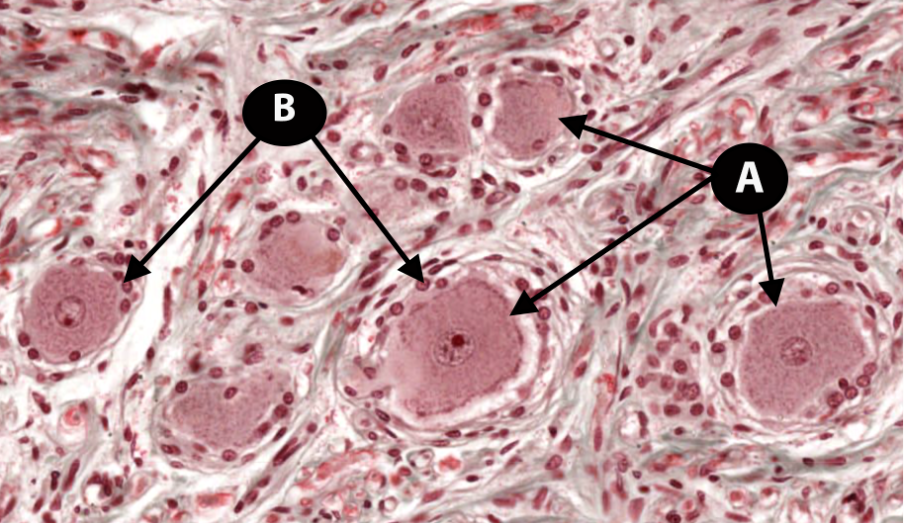
Question 28 What type of neuronal cell bodies are indicated by A?
Question 29 What is the function of the cells indicated by B?
Question 30 State THREE (3) differences between a somatic (dorsal root) ganglion and an autonomic ganglion.
Part D. 10 minutes.
Investigation of Mr. Jones’ claw hand would have included electromyogram (EMG) measurements of action potential (AP) conduction velocity in his arm.
Question 31 Explain the mechanism by which action potentials are conducted along axons AND the factors that affect the velocity of conduction.
Question 32 Some results for EMG measurement of ulnar nerve conduction velocity from a different patient are shown below.
| RESULTS – ULNAR NERVE CONDUCTION VELOCITY | |
|---|---|
| Delay (latency) between stimulation at the wrist and muscle response | 2.3 ms |
| Delay (latency) between stimulation at the elbow and muscle response | 6.3 ms |
| Distance between the two stimulation sites | 24 cm |
| a. Calculate the conduction velocity (m/s) for this section of nerve. | |
| b. How does this compare with normal ulnar nerve conduction velocity? |
Part E. 10 minutes.
This is picture of a normal x-ray of a sacroiliac and hip joint.
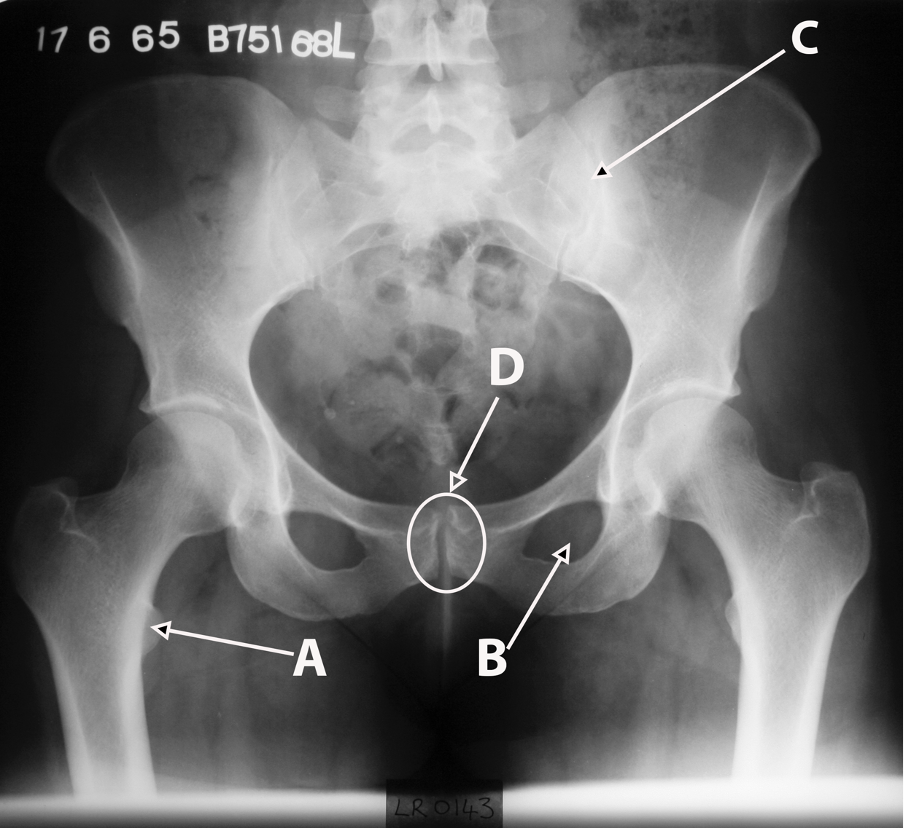
Question 32 Name the muscles that attach to the bony structure labelled A.
Question 33 What is the function of the muscle that attaches to A at the hip joint?
Question 34 Name two principal arteries supplying the hip joint.
Question 35 List the capsular ligaments found in the hip joint.
Question 36 Name two structures passing through the foramen labelled B.
Question 37
a. Name ONE (1) muscle positioned immediately anterior to foramen B and ONE (1) muscle positioned immediately posterior to foramen B.
b. Concentric contraction of these muscles produce what movement of the hip joint?
Question 38 What type of joint is labelled C?
Question 39 Name the ligaments that stabilise the joint labelled D.
Part F. 5 minutes.
This histological image shows a cross-section of a muscle.
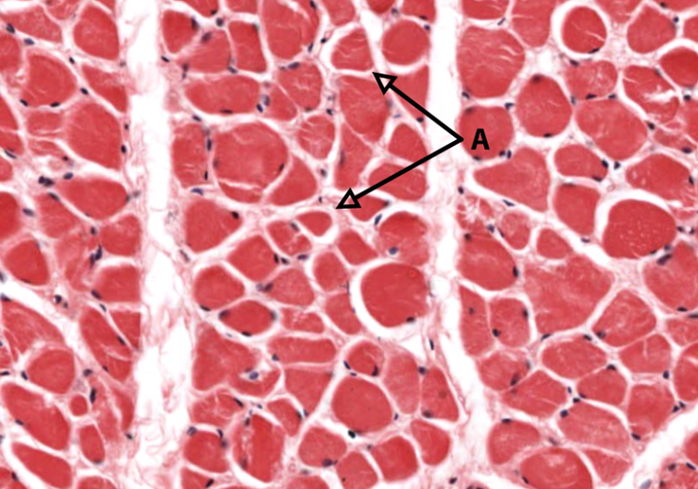
Question 40 Name the connective tissue covering labelled A.
Question 41 Name two functions of this connective tissue (which covers the muscle).
Question 42 What structures contribute to form a T-triad?
Question 43 In which part of a sarcomere are T-triads commonly located?
Part G. 10 minutes.
Mr. Jones’s goes to see his GP for a routine check-up. He appears distressed upon arrival. The GP asks Mr. Jones how he has been feeling lately. Mr. Jones informs the GP that he has been feeling stressed as he has been unable to return to work since the accident several months ago.
During this time, Mr. Jones has been watching more TV and spending more time online than before the accident. One day he saw an advert about an online racing and sports betting gambling app and decided to download it as he has always loved sports. He was feeling bored anyway and thought it would be a great way to occupy himself. He instantly started enjoying the excitement caused by using it and gradually started spending more time on it. He gambled with free credits at first which he felt was okay because he wasn’t spending any real money.
After a few weeks he found this was not exciting enough even though he was winning. This convinced him to spend a few of his own dollars. Soon he started spending larger sums of money and over time started to lose more than he was winning. Upon realising this, he tried to stop by deleting the app, but soon afterwards started feeling restless, agitated, and depressed.
He couldn’t stop thinking about gambling and missed the excitement of it, so he downloaded the app again and immediately felt much better when he started to use it again. He has incurred a lot of financial debt due to this over the past months and wants to stop but doesn’t think he can do it on his own.
Mr Jones asks the GP why he is experiencing this, and whether GP believes Mr. Jones has become addicted to gambling?
Question 44
Use the brain’s pleasure-pain balance in addiction, to explain why Mr. Jones has been experiencing what he told the GP.