Introduction, terminology, and concepts.
Link to glossary: Glossary Symbols of Respiratory Physiology
What is Respiration?
It is the exchange of CO2 and O2 between atmosphere and tissues
- Exchange of O₂ and CO₂ between the atmosphere and blood in the lungs
- Blood containing O₂ and CO₂ from the lungs to tissues that need it.
- O₂ consumption and CO₂ production in tissues
5 steps of respiration
- Ventilation:
- The process of moving air in and out of the lungs to interchange CO2 for O2
- Gas exchange
- How o2 and CO2 moces acress the alveili membrane down their partial pressure gradients
- Gas transport
- The blood leaves the lungs high in o2 ans low in co2 it is pumped around the bofu to the cells via bulk flow
- Gas exchange 2
- At the interface between the capiullaries and the cells there is echange of o2 and co2 down their partial pressure gradients by a process of diffusion
- Cellular respiration
- The cells use the o2 and produce co2
spontaneous but adaptable
Daltons law
Basically this says that the partial pressure of a gas is equal to the total gas pressure multiplies by the fraction of gas that the gas is.
Tracheal air
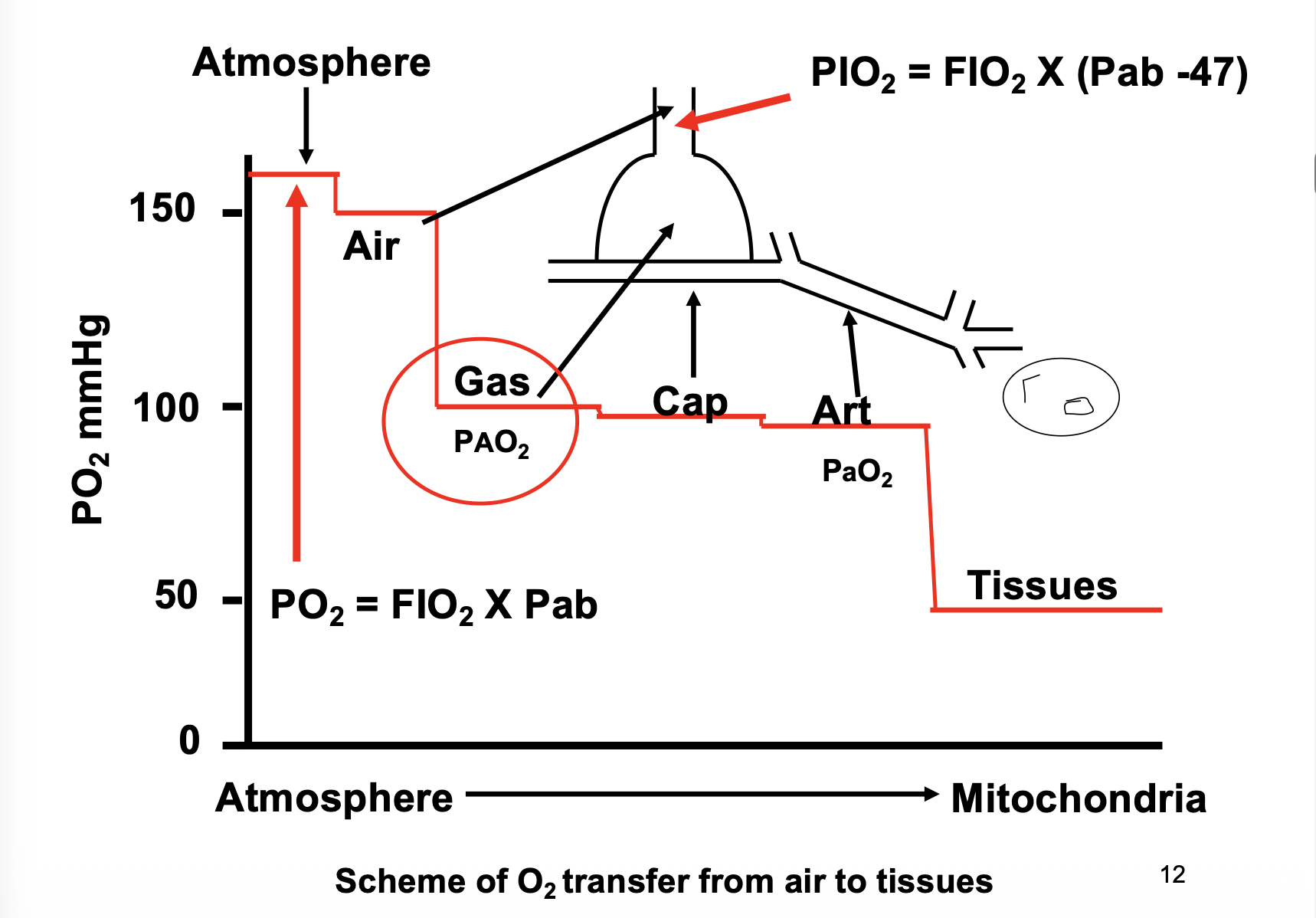
Water vapour pressure is at 47mmHg which reduces the P0₂ by about 10mmHg to 149mmHg. To calculate the pressure of inspired 0₂:
P0₂ changes based on how many barriers you are from atmosphere. The image below shows this well. Additionally these barriers correspond to the 5 steps of respiration/
1. Ventilation
Spoken about in L05 Respiratory Physiology 2 Lung function tests Link to page is here: (Phys) Respiratory Ventilation
pulmonary ventilation is equal to frequency times tidal volume
but the alveolar ventilation is frequency times the air that actuiay gets to the alveolae
2. Gas exchange
Talked about in: L11 Respiratory Physiology 4 Gas exchange and L12 Respiratory Physiology 5 Gas exchange 2 Link to page is here: (Phys) Gas exchange
Ficks law of diffusion determines gas exchange through a membrane and gives us the understanding of the factors that determine this diffusion
where a is surface ares; D is diffusion constant p1 and p2 are pressure difference and t is thickness
This is relevant as in pulmonary disease there can be reduction in surface area and thickening of alveolar membrane. Both of these will impair gas diffusion and make breathing more difficult.
Additionally the pressures in ficks law can be the partial pressure difference seen between alverolar air and venous gases. This determine CO₂ diffusion out and 0₂ diffusion in
3. Gas transport
This is covered in detail in L13 Respiratory Physiology 6 Gas transport and L14 Respiratory Physiology 7 Central control (lowkey changed the names bc matty b chose poor names) Page: (Phys) Gas transport
Essentially oxygen and carbon dioxide are differently transported dut to different chemical properites.
Oxygen is transported both as dissolved gas and bound to haemoglobin. It is transported far more with haemoglobin then as a dissolved gas
Oxygen disassociation curves show how the blood saturation of oxygen changes with the partial pressure of oxygen, which is useful to see as to understand how blood behaves in different levels of hypoxia
CO₂ is transported as dissolved gas (10%), HbCO₂ (20%), and bicarb ions (70%). THe bicarb ions can make the blood more alkaline so are relevant in hyper- and hypo- capnic blood pH changes.
4. Gas exchange
Ficks law comes up again in the diffusion of gas throught he endothelium and isnt given much though in this lecture
5. Cellular respiration
not much mentioned in the lecture on this however this is where O₂ is converted to CO₂